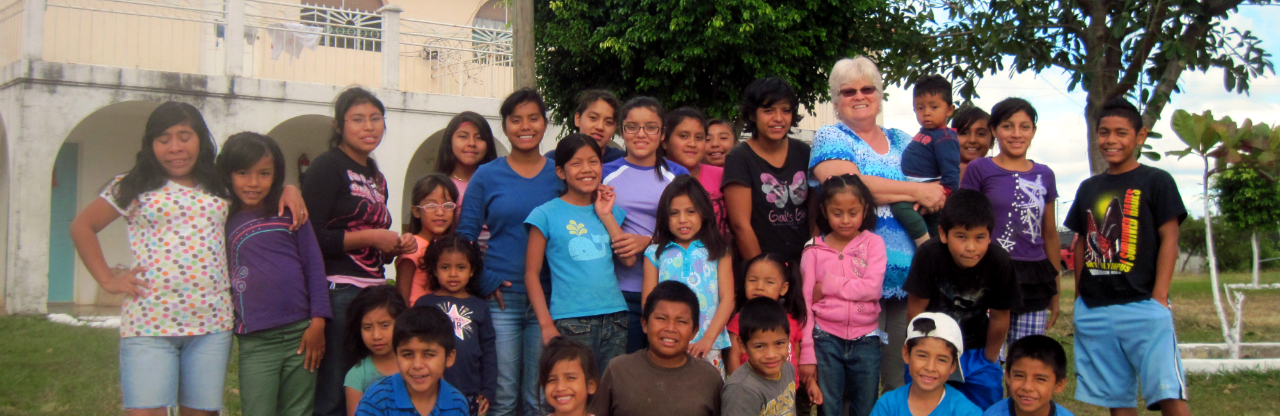
Not An Institution

I attended many court audiences where a group of people would present their perspectives on where best to place a child. A representative from Shadow of His Wings Orphanage, the court social worker, someone from the child’s rights group, the court psychologist, a person representing the child’s family, the child, and the judge made up this group. The first two audiences gave time for case investigation, and during the third audience the judge would make her final decision. I learned quickly that judges oppose the idea of institutions. We had a new government-approved nonprofit association, and yet the courts viewed us as an institution.

A movement in Guatemala followed the States’ way of dealing with children by using foster care and removing orphanages, thus eliminating institutions. During one particular visit at Shadow by a court social worker, I observed her talking seriously with two of our girls. It disturbed me because conversations like that should include the representative of the orphanage. I later talked to Joanne, and after talking with the girls, she found out that the courts were removing children from the institutions. The social worker told the girls about this plan. Did this mean we wouldn’t receive children? We had worked hard to grow the orphanage, and now we would be looking at shutting our doors. We needed to move fast and get ourselves known.

An opportunity presented itself during the next audience. “Your honor, I need to explain that we are not an institution.” I took the liberty to describe to these officials how we structured the orphanage. “We have house parents, a mother and father, who are in charge of up to twelve children. We believe it is important that these children learn how to function in a family, to feel loved, and to know they are an important part of this family structure.” I had this judge’s attention, but there were many other judges and court officials who did not know what we represented. Oh, Lord, may we find favor with these people. Let them see our project for what it is and not as the institutional types present in Guatemala. 

Our next plan went into action, and we invited the judges, social workers, and court officials to come to the orphanage to see where we lived. We took the time to explain our plans and vision for the children. Not many came, but the ones who did expressed how impressed they were with what they saw. I knew that the word would spread to others in time. Meanwhile, we needed to use every opportunity to get our information to all of the children’s courts in Guatemala City.

The day came when my heart jumped for joy. During an audience with one of our girls, the social worker said that an institution like Shadow of His Wings would not be the best place for this child. The judge responded, “This orphanage is not an institution. I visited the Home, and they are functioning as a family. I recommend the child remain there.”

The process seemed slow, but in time more of the judges saw what we had to offer the children and showed us favor. It got to the point where they encouraged us to take in boys and not just girls. One judge suggested that we write up a manual describing our program and make our model available to others interested in developing orphanages. I’m sure my mouth fell open before I thanked her and said that it was a good idea. Inside I’m saying, “Thank you, Lord!” Word spread, and we received requests from surrounding areas of Guatemala City to take children into the Home. Our doors stayed open, and we overfilled our capacity, sending us out to look for a larger facility that allowed for growth.


Speaking Spanglish

It is at the top of every missionary’s list to learn the language of the native people. I looked forward to having the capability to converse with those around me with competency. I desired to develop a knowledge of the customs and build relationships. My abilities with the Spanish language consisted of knowing words like “burrito” and “taco,” so I pushed forward in my classes, having hope that it would all come together for me. Then I stopped in my tracks when I realized what a major task I faced.

I had two great hindrances in front of me: (1) Being in my fifties limited my brain capacity for learning. (2) I am a visual learner, and so far nobody has invented a way for us to see the words people speak. The challenge stood there, and I decided to take it on, because I believed that with the Lord’s help, I could do it. He did say He would give me what I needed when I responded to His call to come to Guatemala.

My hopeful venture with this foreign language soon turned into major frustration. I couldn’t hear the words, especially the verbs in their various tenses. It drove me crazy struggling to comprehend, until my head felt like it would burst. Did I have a cognitive disorder? I studied Spanish at every moment—even in my sleep. Being the “mother” for the children coming into the orphanage, I needed to be able to communicate. It encouraged me to know that people were praying for me, and I believed in miracles. If God could make a donkey talk, then He could help me learn a foreign language.

Someone told me that a person can know they are on their way to learning another language when they dream in that foreign language. I began having dreams where I could speak and understand Spanish with ease and fluency. I rejoiced! That encouragement moved me onward with more determination, and then I went downhill again. Out of my anguish, I cried out to the Lord, “Please remove this mental block.” Then a Scripture verse came into my mind, “Not by might nor by power, but by my Spirit” (Zechariah 4:6). I started praying differently by putting my hands on my head, by my brain, on my ears, and on my mouth. I claimed the hearing and understanding of Spanish. I claimed that I would speak it, remember it, and use it correctly. A change occurred, and I moved forward with confidence. A load lifted from my mind.

IMG_0752.JPGLearning any language is a lifetime adventure. I continued to falter sometimes by totally missing the right words, but moved along with some competency. I learned to laugh with others when I said, “Yo tengo hombre” (I have man), instead of “Yo tengo hambre” (I have hunger). My friend spoke to a congregation at church and said her husband was a dog. That brought laughter, but the people knew what she meant. I pleaded with the Lord never to show me what I really said when I spoke in Spanish. I slaughtered verbs often, and some of the expressions I saw on the hearer of my words left little doubt that I said a “good one.” The Guatemalan people graciously helped me when I searched for the word I needed. I liked the teamwork approach.

After years of the above process, I found a place of peace. It’s not always about using the correct verbs and adjectives in their proper places. I’m not in a position that requires such competency, and I am grateful for that. It’s about communicating, and communication takes other forms, like body language. I also found that speaking Spanglish works great in many situations. I am at home in this country and feel comfortable with what I lack in speaking the language, but I’m open to learning more each day.

Biologically Related Strangers

Within two weeks of the court audience, the house parents came to me saying that the two recently reunited sisters would not talk to each other. They wouldn’t respond except to walk away with their noses in the air. Carmin* didn’t provoke negative action, but out of loyalty, most of the girls sided with Vanesa.* I knew intervention would be needed in this delicate situation but was not sure what. I told the house parents that I’d visit with each girl to find out what could be done to help them. I discouraged the idea of discipline, because forcing a relationship would not bring the desired results. Love needed time to bloom.

“Hey, Carmin, how are you doing? It’s been what, two weeks since you joined us? Is there anything I can help you with?” I asked, hoping to open the door to her feelings.

“It’s okay,” she replied, but her downcast eyes didn’t convince me of this. She scooped out some more dirt from the flowerbed she was working in.

“Are you adding some more plants?” I asked, looking at the order of the new plants. I was impressed. She knew what she was doing.

“Yes, there aren’t enough plants in this part.” She huffed as she took out another shovelful of dirt.

“Your house parents are troubled about your relationship with your sister. I need to have you tell me what you think is happening.”

“Mama Carroll, she won’t talk to me. I try to be nice to her and help her, but she pushes me away and won’t talk.”

“Carman, you have entered Vanesa’s territory, and to her, you are a stranger. It will take time for her to accept you as her older sister. She told me there isn’t any memory of you in the past, so it is as if she just met you for the first time. I can see how patient you have been, and I thank you for that and for not getting into verbal confrontations with her.”

Later, I talked to Vanesa. “Do you feel like an intruder moved into your home?”  I asked. Looking up with a half-smile, she shook her head yes. “I’m sure it feels that way, but think of how you would feel if you finally found the sister you loved and had taken care of and, for no reason, she wouldn’t accept you.”

Vanesa’s head went back down to avoid looking at me, while her fingers followed the creases in her skirt. Trying to reach down inside of her, I quietly asked, “Vanesa, are you afraid that she will treat you badly?”

The silence seemed to stretch for minutes before she said, “I don’t know why I don’t want to talk to her.”

IMG_5954  “Vanesa, you are already accepted as part of the Shadow family, and that’s not going to change. Carmin gave up the family she knew to come live with you. Mi Amor, how about you respond to Carmin as you would anyone else in the orphanage, as a friend, being nice and smiling. Let’s see where the relationship goes from there. You know the Lord will help you with this. Let’s ask Him now.” We prayed, and I let her leave the office.

The Shadow team took opportunities to pray and encourage these two. A couple months later, I saw these two biologically related strangers standing together laughing. It was a photo moment, and I didn’t have a camera! Thank you, Lord, for your goodness and love. I saw peace and happiness on their relaxed faces as they shared a special moment together. They finally found each other, and a relationship began to bud. All of us at the Project rejoiced to see the beginning of God’s plan for Carmin and Vanesa coming together.

*Names have been changed.

God’s Plan for Carmin*

Most of the children who come to Shadow of His Wings Orphanage don’t expect to be placed here. They wait in the children’s court for the custody decision of the judge. The judge has two options: Place the child with a family member or adult friend, or send the child to an orphanage. Carmin’s case had a different slant to it. She lived with her grandfather in a safe environment, taking care of him while he provided a meager life for her. She didn’t have a reason or desire to change that. However, her world shook when she sat in her sister’s audience and heard her grandfather’s idea. He wanted his newly found granddaughter to stay in Shadow and for Carmin to go live with her. I believed this to be God’s plan for Carmin.

The loss of color in Carmin’s face and the moist dark eyes were the only visible clues to her reaction. She outwardly accepted everything that her grandfather and the judge decided for her, but I knew her insides had to be in turmoil. Saying good-bye to the grandfather turned out awkward for both girls. Vanesa* didn’t know him, and Carmin didn’t want to say good-bye. Concerned about her clothes and personal items, I assured her that we would have everything she needed.

The three hour trip to Monjas didn’t open any doors for reconciliation. These two hadn’t been together for ten years, and Vanesa didn’t seem to care if that changed. Vanesa, separated from her family at three years of age, didn’t remember Carmin. She scooted up tightly to the window and kept her eyes glued outside, acting like she might miss seeing something as we passed by. Carmin’s few words, while trying to invite conversation, met with silence. Gerber took the position of a peacemaker, but that fell flat too, since only I responded. Oh, Lord, we have our work cut out for us. Restore this relationship, and fill these girls with your love for one another. Guide us in helping with this huge transition.

Children came running and shouting with excitement when they saw us driving up to Vanesa’s home. Curiosity as to what caused such a ruckus brought out the house parents. Now in her familiar territory, Vanesa left Carmin and ran off with her friends. I introduced Carmin to the house parents, who responded with words of welcome, and then I took her to the storeroom for the normal clothing and necessities allotment.

“Vanesa just needs some time to adjust to the idea that you are her sister. She has fought the ‘battle of life’ alone for a long time, and it will be hard for her to trust you immediately.” I felt like I did all the talking, but I continued to give her the “new at Shadow” spiel. Carmin listened intently and smiled, but few words came out of her mouth. This girl needs time to adjust to us too.

My mind tried to land on some ideas to help these two biologically related strangers develop a “friend” relationship.  I believed if they could start there, the rest would take place naturally. Both girls took responsibility well and had leadership giftings. We all saw a maturity that lacked in many of the kids the same age. The teachers and house parents confirmed this to us. I assured myself that it wouldn’t take long for both girls to find each other as sisters and readjust their lives. If only it were that easy.

*Names have been changed.